
Nail Drill Bits Guide: Types, Materials, and Uses by Service Task
Compare nail drill bit materials, shapes, fit, and uses by service task.
Two nail drill bits can look almost identical and still be intended for different jobs. One may be designed to remove product from a broad area, while another is better suited to refining a smaller section. Material matters, but so do shape, coarseness, and fit with the handpiece.
That is why a useful nail drill bit guide should not begin with a random list of attachments. It should begin with the service task. Once you know what needs to be removed, refined, shaped, or detailed, you can narrow the options by material, shape, cutting level, and handpiece fit.
Nail Drill Bit Types at a Glance
Four factors work together when you compare nail drill bits. Each one changes a different part of the service:
| Selection factor | How it affects the nail service | Typical choice direction | What can happen when it is mismatched |
|---|---|---|---|
| Material | Determines whether the working surface cuts with flutes or abrades with a coated surface or band. This affects which product layer and service stage the bit is designed to address. | Fluted carbide is commonly considered for reducing enhancement product; diamond and abrasive bands are often considered for refining, shaping, or more controlled surface work. | The bit may remove product inefficiently, require unnecessary passes, or produce a finish that does not match the next service step. |
| Shape | Controls the contact area and how easily the bit reaches broad surfaces, contours, transitions, or limited spaces. | Barrel and cylinder shapes cover a broader area; cone, tapered, and smaller shapes offer a narrower working profile. | A broad shape may lack access or precision, while a narrow shape can make work across a large area slower and less even. |
| Coarseness | Controls how much product the bit can remove relative to other options in the same range and how refined the resulting surface will be. | Coarser options are generally considered for reduction or removal; finer options for refining and finishing. | An option that is too coarse can remove more product than intended or leave a rougher surface; one that is too fine may work slowly and require more passes. |
| Shank and interface | Determines whether the bit seats securely in the handpiece or chuck and rotates as intended. | Match the shank specification to the exact handpiece and model. | An incompatible bit may not insert or lock correctly, may run unstably, or may be unusable with the equipment. |
No single factor answers the whole question. A carbide bit is not one fixed tool, and a cone shape is not one fixed application. The final role comes from the complete combination, while the exact grade labels and compatibility still need to be checked for the chosen product range.
Nail Drill Bit Materials Explained
The material changes how the working surface is built, but it does not work independently from shape and grade. This comparison gives the reader a practical first filter:
| Material or attachment | How it works at a high level | Common service direction | Main buying check |
|---|---|---|---|
| Carbide | Cutting flutes slice through enhancement product | Bulk reduction, gel or acrylic removal, and reshaping enhancements | Flute pattern, shape, cutting level, direction requirement, and product layer |
| Ceramic | A shaped ceramic working section comes in different cutting levels | Product removal or surface refining, depending on the design | Shape, cutting level, intended task, condition, and compatibility |
| Diamond | An abrasive-coated surface comes in different shapes and sizes | Controlled refining and detail work | Abrasive level, shape, dimensions, coating condition, and working area |
| Sanding band | A replaceable abrasive sleeve fits over a mandrel | Surface preparation, shaping, and refining | Band and mandrel fit, abrasive level, intended surface, and handling instructions |
These are shortlist directions rather than operating instructions. A coarse removal profile and a fine detail profile can share the same base material while serving very different jobs.
Carbide Bits
Carbide bits use cutting flutes rather than an abrasive sleeve. They are commonly used to reduce bulk, remove gel or acrylic product, and reshape enhancements.
The flute pattern and cutting level affect how aggressively the bit removes product, while the shape determines the size and contour of the working area. This is why a broad carbide barrel and a narrower tapered carbide bit may serve different steps even though both are made from carbide.
Ceramic Bits
Ceramic bits also come in different shapes and cutting levels. Coarser ceramic designs are commonly selected for product removal, while finer designs may be used to refine remaining product or smooth a transition. The exact role still depends on the bit’s shape, condition, and intended application—not the material name alone.
Diamond Bits
Diamond bits use an abrasive working surface rather than cutting flutes. They are commonly used for controlled refining and detail work, with smaller or tapered shapes offering access to more limited areas. The abrasive level, working-area size, and edge design determine whether a diamond bit is suited to light refining, surface work, or a more precise task.
Sanding Bands and Mandrels
A sanding band is an abrasive sleeve fitted over a mandrel. The two components should be identified separately even when they are sold together. Bands may be offered in different abrasive grades, while the mandrel must match the band and the intended handpiece.
Check that the band fits the mandrel, that its abrasive level matches the intended surface, and that its handling instructions are clear. For cleaning, inspection, and storage guidance, see how to clean and maintain nail drill bits.
Common Nail Drill Bit Shapes
Material describes what the working section is made from; shape describes how that section meets the work area. The following profiles are common starting points when comparing a bit set.
Barrel and Cylinder Profiles
Barrel and cylinder shapes provide a broader working profile than narrow or tapered bits. Buyers commonly compare them for tasks involving a larger product area, such as removal, reduction, or surface refining.
The edge design matters. Two barrel-style bits may differ at the top, along the side, or in their taper, which can change the area they are intended to contact. Compare the dimensions, cutting level, and recommended product layer before adding one to a service kit.
Cone and Tapered Profiles
A cone or tapered profile becomes narrower toward one end. That geometry may make it a candidate for transitions, contours, or areas where a full-width barrel would not be the first shape considered.
Edge design, dimensions, and cutting level determine whether a particular cone is intended for removal, refining, or a more detailed task. Two cone-shaped bits should not be treated as interchangeable simply because their outlines look similar.
Small Detail Profiles
Smaller profiles are commonly reviewed for controlled work in limited areas. They may appear in diamond, carbide, ceramic, or other constructions, so size and shape cannot be separated from material and grade.
Before using a small detail bit near the sidewall or cuticle area, check the intended working area, edge design, and abrasive level, and make sure the technician has been trained for that application.
Which Nail Drill Bits Should You Consider for Each Service Task?
Use the table below to build a practical shortlist. The final choice still depends on the product being worked on, the handpiece, the bit’s exact design, and the technician’s training.
| Service task | Common starting candidates | What changes the final choice |
|---|---|---|
| Removing an existing gel or acrylic product layer | Carbide or ceramic removal bits; broader barrel, cylinder, or suitable tapered shapes | Product type and thickness, cutting level, direction requirement, handpiece compatibility, and operator training |
| Refining remaining product or smoothing a transition | Finer ceramic, diamond, carbide, or sanding-band options | Surface being refined, desired finish, abrasive or cutting level, dimensions, and product instructions |
| Detail work in a limited area | Small or tapered detail bits, often including diamond options | Exact working area, edge design, dimensions, restrictions, and professional training |
| Shaping or working at a free edge | Sanding bands or suitable barrel, cylinder, or tapered bits | Nail or enhancement material, desired form, abrasive level, shape, and equipment compatibility |
For sample evaluation, label each candidate with its intended task before testing the assortment. This makes it easier for product managers and trainers to compare like with like instead of judging an unlabeled mixed set by appearance alone.
Three distinctions make this task map more useful:
- Removal is not the same as refining. Removal usually starts with the product layer and the amount to be reduced; refining focuses on remaining product, a transition, or the desired finish.
- Small does not automatically mean suitable for detail work. The intended area, edge design, dimensions, restrictions, and training requirement still need to match.
- Shaping starts with the material being shaped. A band or shaped bit should be compared against that material, the desired form, and the product range’s own cutting or abrasive levels.
Keep the grade key for the chosen bit range with the kit. Terms such as fine and medium—or a familiar color band—should not be copied across brands without checking what they mean in that range.
B2B Checklist for Comparing Nail Drill Bit Sets
Before approving a set, requesting samples, or preparing a product listing, confirm:
- The material, shape, dimensions, and exact item code for each bit.
- The grade, cutting-pattern, or color-label key for the product range.
- The product layers and service tasks assigned to each item.
- Shank specifications and confirmed handpiece or chuck compatibility.
- Any direction, handling, inspection, or replacement instructions.
- Which bands, mandrels, and other components are included separately.
- Whether samples, images, packaging labels, and quoted specifications match.
- How specification changes will be recorded before a repeat order.
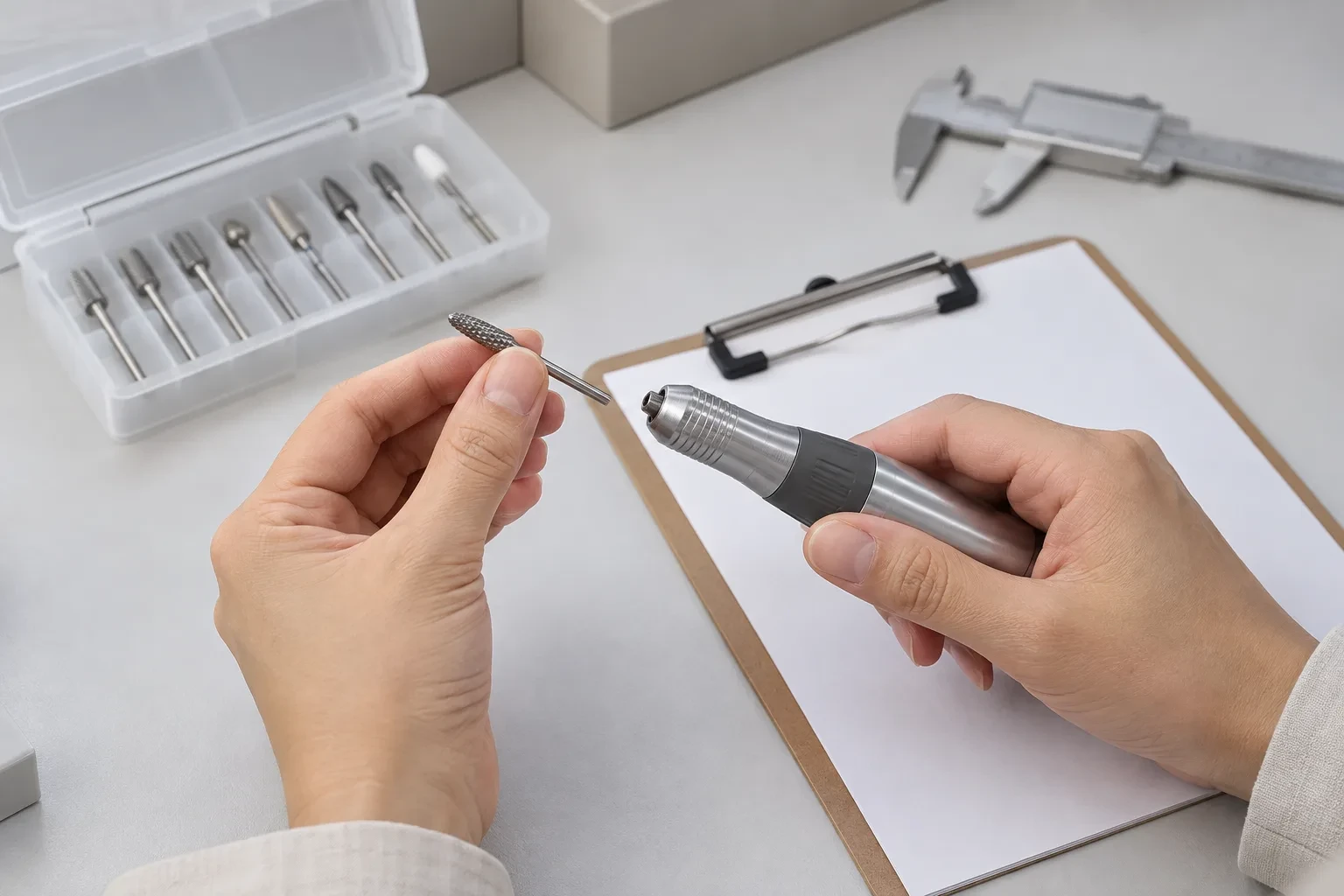
Check bit fit and sample consistency against the intended nail drill and handpiece.
This checklist is more useful than counting pieces. A smaller set with clear roles and traceable specifications may be easier to sell, teach, and reorder than a larger assortment with no dependable task map.
Key Takeaways
Start with the service task, then compare material, shape, coarseness, and interface. Carbide and ceramic options commonly appear in removal or refining categories; diamond and smaller designs often appear in detail-oriented options; sanding bands require a matching mandrel and their own grade and handling information. These are starting categories, not automatic instructions for every product.
For distributors, training teams, and salons, the goal is a kit in which every item has a clear identity, intended task, compatible equipment, and matching product information.
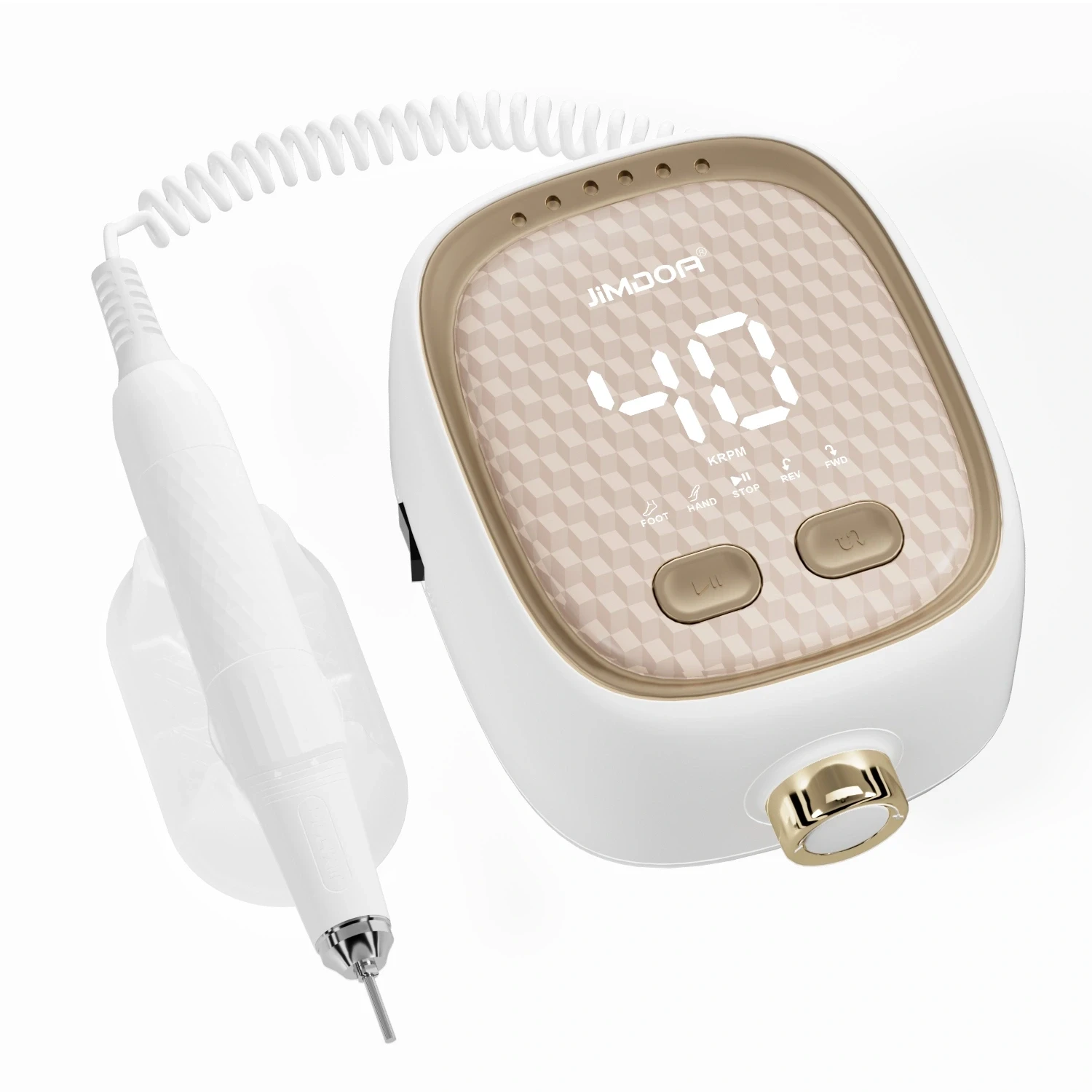
Review professional nail drill equipment for compatible bit-set planning.
Building a private-label bit set or matching bits to a nail drill range? Share your target services, handpiece interface, preferred materials and grades, and market requirements. Jimdoa can help review the configuration, samples, and documentation needed for your OEM/ODM project.
FAQs
Are nail drill bit color bands universal?
Do not assume that they are. Use the grade or color key supplied for the exact product range you are buying.
What matters more: shape or coarseness?
They answer different questions. Shape affects the working profile and contact area, while coarseness describes the relative cutting or abrasive level within that supplier’s range. Both must be considered with material and interface.
What information should come with a professional nail drill bit set?
Each item should have an identifiable material, shape, cutting or abrasive level, intended task, shank specification, compatibility statement, and handling information. The item codes, images, samples, packaging labels, and quoted specification should refer to the same products.